Common Mistakes When Purchasing Conveyor Equipment
ZhengZhou TianQi Machinery Co., Ltd.
2026-08-16
Misconception Correction
ZhengZhou TianQi Machinery Co., Ltd. explains why conveyor equipment buyers should evaluate more than price and individual specifications, including material characteristics, site layout, maintenance, after-sales service, and supplier capabilities.
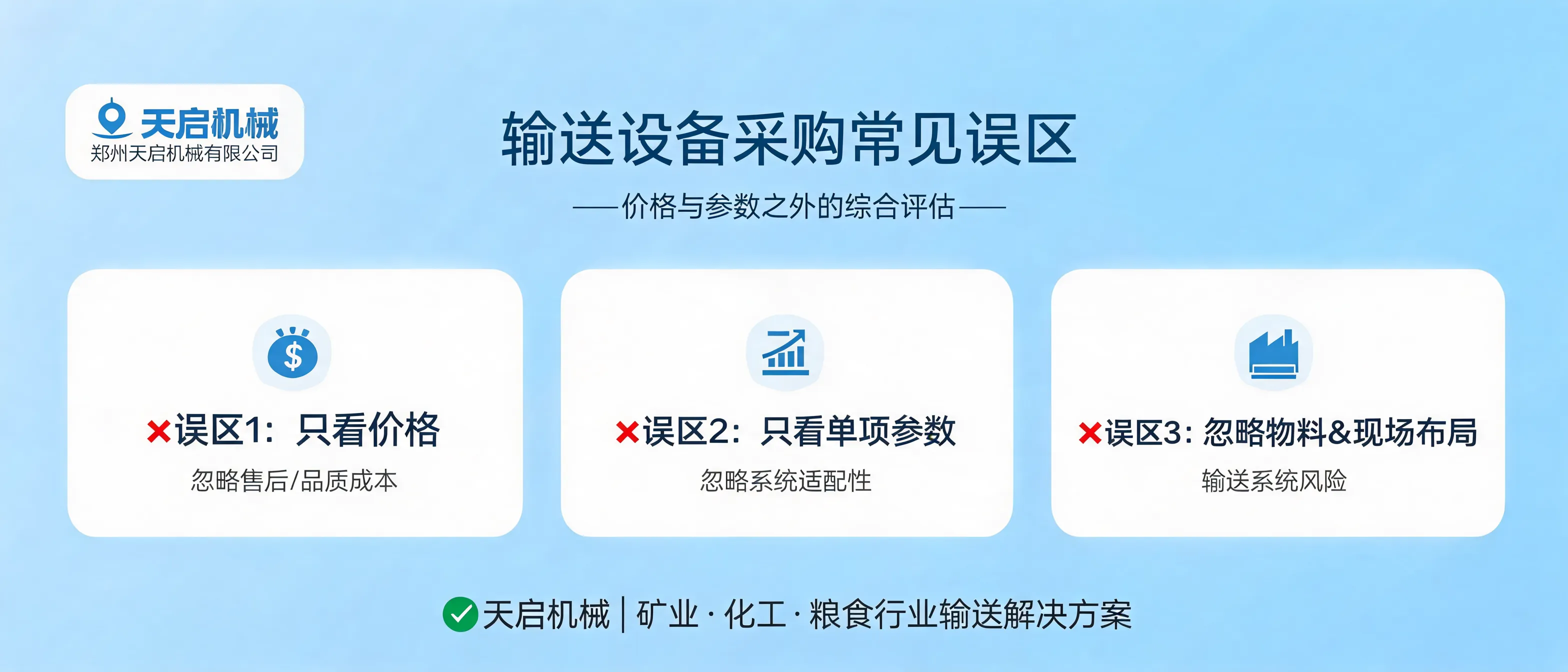
Selecting conveyor equipment is not simply a matter of finding the lowest price or choosing a machine with an attractive specification sheet. For mining, chemical, grain, and other material-handling applications, the purchasing decision should reflect the material, the working environment, the layout of the site, system compatibility, maintenance requirements, and the supplier’s ability to provide dependable support.
Why a Single-Machine Comparison Can Be Misleading
A conveyor is part of a complete handling system. Belt conveyors, chain bucket conveyors, screw conveyors, and vertical elevators each serve different conveying purposes and operating conditions. Comparing equipment only by price, capacity, or dimensions may overlook factors that influence the suitability and long-term usability of the overall solution.
A more reliable evaluation begins with the actual application. Buyers should first define what needs to be conveyed, how the equipment will be arranged, and how the conveyor will interact with upstream and downstream processes. This system-oriented approach helps reduce avoidable purchasing risks.
Common Purchasing Mistakes to Avoid
1. Choosing Mainly by Price
A lower initial price does not necessarily represent better value. If the equipment is not suited to the material, layout, or operating conditions, additional modifications, maintenance, or replacement may create greater costs over time. Price should be evaluated together with suitability, construction requirements, serviceability, and supplier support.
2. Focusing Only on Individual Specifications
Capacity, conveying distance, lifting height, and equipment dimensions are important, but they should not be reviewed in isolation. The selected unit must also match the complete conveying route, connection points, material flow, and operating requirements of the project.
3. Underestimating Material Characteristics
Material properties influence equipment selection. Particle size, bulk behavior, moisture, flowability, temperature, and other application conditions may affect the appropriate conveyor type and configuration. A purchasing decision based on incomplete material information can lead to an unsuitable system design.
4. Ignoring the Site Layout
Available space, conveying direction, elevation changes, access points, and the relationship between connected equipment should be considered before ordering. A conveyor that appears suitable on paper may require changes if the site conditions are not fully assessed.
5. Treating Maintenance as an Afterthought
Buyers should understand how the equipment will be inspected, maintained, and serviced during operation. Access for routine work, the availability of technical information, and the clarity of maintenance responsibilities are important parts of the purchasing evaluation.
6. Overlooking Supplier Capabilities
The supplier should be evaluated not only by the product offered, but also by its ability to understand the application, coordinate system requirements, communicate clearly, and provide appropriate after-sales support. This is particularly relevant when equipment is purchased across borders.
A Practical Evaluation Framework
Before comparing quotations, buyers can organize the evaluation around the following areas. This creates a clearer basis for supplier discussions and helps separate essential requirements from optional preferences.
| Evaluation area |
Questions to clarify |
| Material |
What material is being conveyed, and what characteristics may affect conveying performance? |
| Site layout |
What are the conveying distance, direction, elevation, space limitations, and connection requirements? |
| System compatibility |
How will the conveyor connect with existing or planned feeding, processing, storage, or discharge equipment? |
| Maintenance |
What routine inspection, cleaning, adjustment, and service access will be required? |
| Supplier support |
Can the supplier provide application communication, technical coordination, documentation, and after-sales assistance? |
The Importance of Complete Conveyor Solution Thinking
A reliable conveyor purchasing decision connects equipment selection with real operating conditions. Instead of asking only which machine is cheapest or which specification is highest, buyers should ask whether the proposed equipment fits the material, site, process, maintenance plan, and future supplier relationship. This approach supports clearer communication and more practical project planning.
How ZhengZhou TianQi Machinery Supports Equipment Evaluation
ZhengZhou TianQi Machinery Co., Ltd. is a China-based manufacturer focused on the research, production, and export of conveying equipment. Its product range includes belt conveyors, chain bucket conveyors, screw conveyors, and vertical elevators, serving material-handling requirements in industries such as mining, chemicals, and grain processing.
With a professional research and development team and after-sales service capabilities, TianQi Machinery approaches conveyor purchasing as a solution evaluation rather than a simple single-machine transaction. Buyers can use the material, layout, compatibility, maintenance, and supplier-support criteria above to communicate their requirements more accurately and assess whether a proposed conveyor solution is appropriate for the intended application.
A sound purchasing decision starts with the application.
Evaluate the complete conveying requirement—not only the equipment price or a single specification—so that the selected solution is aligned with the material, site, system, maintenance needs, and supplier support expected for the project.


.png?x-oss-process=image/resize,h_100,m_lfit/format,webp)
.png?x-oss-process=image/resize,h_100,m_lfit/format,webp)
.png?x-oss-process=image/resize,h_100,m_lfit/format,webp)