.png?x-oss-process=image/resize,h_100,m_lfit/format,webp)
.png?x-oss-process=image/resize,h_100,m_lfit/format,webp)
.png?x-oss-process=image/resize,h_100,m_lfit/format,webp)

Industrial Conveyor Selection
Selecting conveyor equipment requires more than comparing product names. The suitable system should match the material, conveying direction, distance, capacity, operating temperature, layout conditions, and industry requirements. ZhengZhou TianQi Machinery provides conveyor equipment selection guidance for mining, chemical, grain, food processing, and other industrial applications, helping customers define a practical equipment configuration before project implementation.
A clear evaluation of the conveying conditions can reduce configuration risks and support more reliable system planning. The following factors should be considered together rather than separately.
Consider material temperature, particle condition, handling requirements, and compatibility with carbon steel, 201 stainless steel, or 304 stainless steel construction.
Confirm whether the process requires horizontal, inclined, vertical, or combined conveying within a complex plant layout.
Define the required throughput and conveying distance so the equipment size and system configuration can be assessed appropriately.
Temperature, chemical process conditions, maintenance access, and available installation space all influence the final conveyor selection.
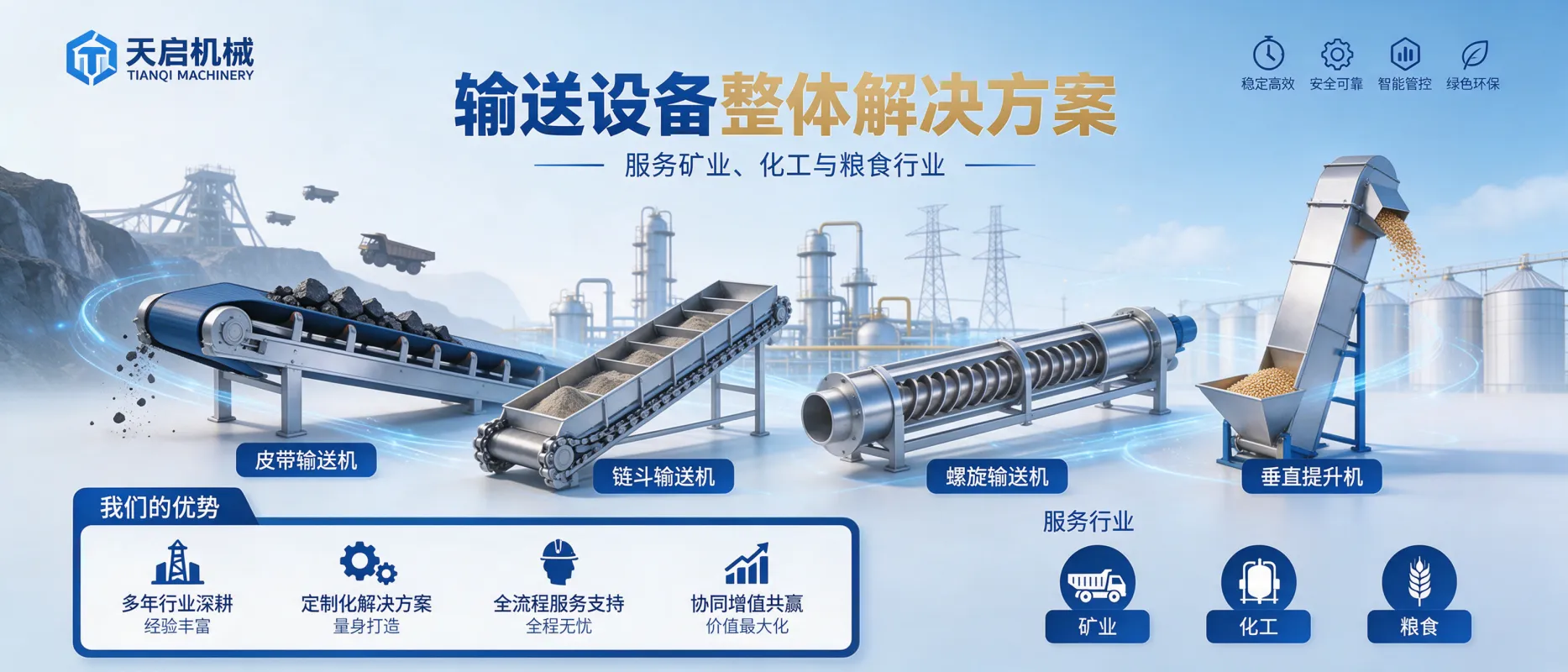
Different conveyor types serve different process requirements. This overview can be used as an initial screening reference before detailed engineering review.
| Conveyor type | Selection focus | Typical evaluation direction |
|---|---|---|
| Belt conveyor | Material handling requirements and route arrangement | Review material, conveying distance, capacity, and horizontal or inclined layout needs |
| Chain bucket conveyor | Vertical or elevation-related conveying requirements | Review material characteristics, required lifting direction, capacity, and installation space |
| Screw conveyor | Process route and material handling conditions | Review material properties, conveying distance, process environment, and maintenance requirements |
| Vertical lifting conveyor | Space-saving elevation changes and vertical transfer | Review lifting height, material flow, capacity, and integration with connected equipment |
A metal mesh belt conveyor can be considered when the process requires continuous conveying through horizontal, inclined, or vertical routes, particularly in applications involving elevated material temperatures or demanding industrial environments.
ZhengZhou TianQi Machinery’s mesh belt conveyor is designed for applications such as high-temperature industrial drying, chemical cooling processes, and food processing lines. Its construction options include carbon steel, 201 stainless steel, and 304 stainless steel, allowing the equipment configuration to be aligned with the operating environment and material-handling requirements.
The conveying capacity can reach up to 526 m³/h, subject to the specific material and system configuration.
The equipment can convey materials with temperatures of up to 600°C, supporting selected high-temperature process applications.
The system supports horizontal, inclined, and vertical conveying for installations with complex spatial requirements. The maximum stated inclination is 60°.
Separating the traction chain from the load-bearing chain simplifies the structure and supports easier maintenance. Rolling bearings on the rollers can reduce friction by 55%–65%.
Wear-resistant alloy steel components are used to support long-term service in demanding conveying conditions.
From non-standard design to system integration, the equipment can be developed around the customer’s process layout and application requirements.
The final conveyor type should be selected according to the complete process requirement. For high-temperature drying, chemical cooling, or food processing applications requiring a continuous mesh conveying surface, the metal mesh belt conveyor can provide a focused solution for further technical assessment.
ZhengZhou TianQi Machinery combines conveyor equipment manufacturing, non-standard design, system integration, and after-sales support to help customers evaluate suitable conveying solutions. The company provides a stated 98% on-time delivery rate and a 2-hour response guarantee, supporting communication throughout the project process.
Share your material type, required capacity, conveying direction, distance, temperature, and layout conditions to support a more accurate conveyor equipment recommendation.

 184
|
184
|
 ZhengZhou TianQi Machinery industrial conveyor equipment belt conveyor bucket conveyor conveyor equipment selection
277
|
ZhengZhou TianQi Machinery Co., Ltd. conveyor equipment manufacturer mesh belt conveyor conveyor solutions conveyor equipment export
181
|
ZhengZhou TianQi Machinery foreign trade intelligent marketing management platform foreign trade customer development customs data foreign trade CRM
91
|
ZhengZhou TianQi Machinery Co., Ltd. industrial conveyor equipment conveyor equipment solutions material conveying conveyor equipment supplier
46
|
ZhengZhou TianQi Machinery conveying equipment solutions belt conveyor bucket chain conveyor mesh belt conveyor
ZhengZhou TianQi Machinery industrial conveyor equipment belt conveyor bucket conveyor conveyor equipment selection
277
|
ZhengZhou TianQi Machinery Co., Ltd. conveyor equipment manufacturer mesh belt conveyor conveyor solutions conveyor equipment export
181
|
ZhengZhou TianQi Machinery foreign trade intelligent marketing management platform foreign trade customer development customs data foreign trade CRM
91
|
ZhengZhou TianQi Machinery Co., Ltd. industrial conveyor equipment conveyor equipment solutions material conveying conveyor equipment supplier
46
|
ZhengZhou TianQi Machinery conveying equipment solutions belt conveyor bucket chain conveyor mesh belt conveyor