Common Conveyor Equipment Purchasing Mistakes: Why the Lowest-Priced Unit May Not Fit Your Project
ZhengZhou TianQi Machinery Co., Ltd.
2026-08-11
Misconception Correction
ZhengZhou TianQi Machinery explains why low-priced standalone conveyor equipment may not meet project needs and how to evaluate cost, stability, maintenance, and supplier support.
A practical guide for B2B conveyor equipment buyers
Selecting conveyor equipment for a mining, chemical, grain, or other material-handling project requires more than comparing the purchase price of individual machines. A low-priced unit may appear attractive at the quotation stage, but it may not match the material, capacity, site conditions, integration requirements, or long-term maintenance plan of the project.
ZhengZhou TianQi Machinery Co., Ltd. helps B2B buyers assess conveyor solutions from a broader project perspective, including system stability, lifecycle cost, supplier capability, export requirements, and after-sales support.
The initial price is only one part of the purchasing decision
Conveyor equipment is part of a material-handling system. Its value depends on how reliably it performs in the intended operating environment and how effectively it works with upstream and downstream equipment. A lower quotation can become more expensive if it leads to frequent adjustments, difficult maintenance, production interruptions, replacement of unsuitable components, or additional integration work.
Common purchasing mistakes to avoid
1. Choosing equipment by price alone
A quotation for a standalone conveyor may exclude important requirements such as supports, feeding and discharge arrangements, control coordination, safety provisions, installation considerations, or project-specific modifications. Comparing only the machine price can make different scopes appear equivalent when they are not.
2. Providing incomplete material information
Material characteristics directly affect equipment selection. Bulk density, particle size, moisture, temperature, abrasiveness, flowability, and the risk of dust or contamination should be considered before confirming a conveyor configuration.
3. Treating capacity as a single number
A stated conveying capacity should be evaluated together with operating hours, loading consistency, conveying distance, incline, discharge requirements, and the required level of process continuity. Nominal capacity may not represent actual project performance.
4. Ignoring site and system conditions
Available space, height restrictions, transfer points, route changes, environmental conditions, access for inspection, and the relationship with other equipment all influence conveyor selection. A machine that fits a catalogue description may not fit the actual site.
5. Evaluating a unit instead of the complete solution
Belt conveyors, bucket elevators, screw conveyors, and other conveying equipment may perform different functions within one process. Selecting each unit independently without reviewing the complete material flow can create compatibility and control challenges.
6. Leaving maintenance and support until the end
Access to wearing parts, inspection points, technical documentation, troubleshooting support, and communication after delivery can influence the practical operating cost of a conveyor system. These points should be discussed before the purchase order is finalized.
What to evaluate before selecting conveyor equipment
A structured evaluation helps buyers compare suppliers and proposals on the same basis. The following areas are particularly important for B2B projects:
| Evaluation area |
Questions for the buyer and supplier |
| Material characteristics |
What material will be conveyed? What are its density, particle size, moisture, temperature, abrasiveness, and flow behavior? |
| Capacity and duty |
What throughput is required, and under what operating schedule and loading conditions will the equipment run? |
| Site conditions |
What are the conveying distance, elevation, route, available footprint, transfer points, and local environmental conditions? |
| System integration |
How will the conveyor connect with feeding, screening, processing, storage, packaging, or discharge equipment? |
| Maintenance access |
Can operators inspect, clean, adjust, and replace relevant components safely and efficiently? |
| Supplier support |
Does the supplier provide clear technical communication, documentation, delivery coordination, and after-sales assistance? |
| Export and compliance requirements |
What destination-country requirements, project specifications, shipping conditions, and documentation need to be confirmed? |
Understanding lifecycle cost of conveyor systems
Lifecycle cost is the total cost associated with acquiring and operating a conveyor solution over its useful service period. It is broader than the initial equipment quotation and should be reviewed during technical and commercial comparison.
- Purchase scope: Review what is included in the equipment price, including the main machine, supporting components, controls, documentation, and any required modifications.
- Installation and integration: Consider the work required to position the equipment, connect it to the existing process, and coordinate it with related machinery.
- Operating requirements: Assess energy use, operator involvement, expected duty, material behavior, and the conditions that may affect stable operation.
- Maintenance and replacement: Identify inspection needs, wear components, adjustment points, spare-parts access, and the technical knowledge required for routine service.
- Downtime risk: Consider how equipment instability, delayed support, or difficult troubleshooting could affect the continuity of the overall process.
A reliable purchasing process starts with clear project information
Before requesting or comparing quotations, buyers should prepare the information that directly affects conveyor selection. Clear input allows suppliers to assess the application instead of offering an unsuitable standard unit based on limited details.
- Material name and relevant physical characteristics
- Required capacity and operating schedule
- Conveying length, height, direction, and layout constraints
- Loading, discharge, and connection conditions
- Environmental, safety, export, and documentation requirements
- Expected maintenance approach and preferred level of supplier support
Selecting the right type of conveying equipment
Different conveyor types address different material-handling conditions. The choice should be based on the process function and site requirements rather than on equipment price alone.
Belt conveyors
Often considered for continuous conveying over a defined route. Selection should account for material properties, conveying distance, loading conditions, incline, and transfer design.
Bucket elevators
Used for vertical lifting applications where elevation change and controlled feeding are important. Material behavior and discharge conditions should be reviewed carefully.
Screw conveyors
May be suitable for controlled movement of certain bulk materials over shorter routes or within process areas. Material flow and handling characteristics are important selection factors.
Integrated conveying solutions
Projects using multiple conveyor types require attention to transfer points, sequencing, layout, access, and coordination between equipment units.
How ZhengZhou TianQi Machinery supports a more informed decision
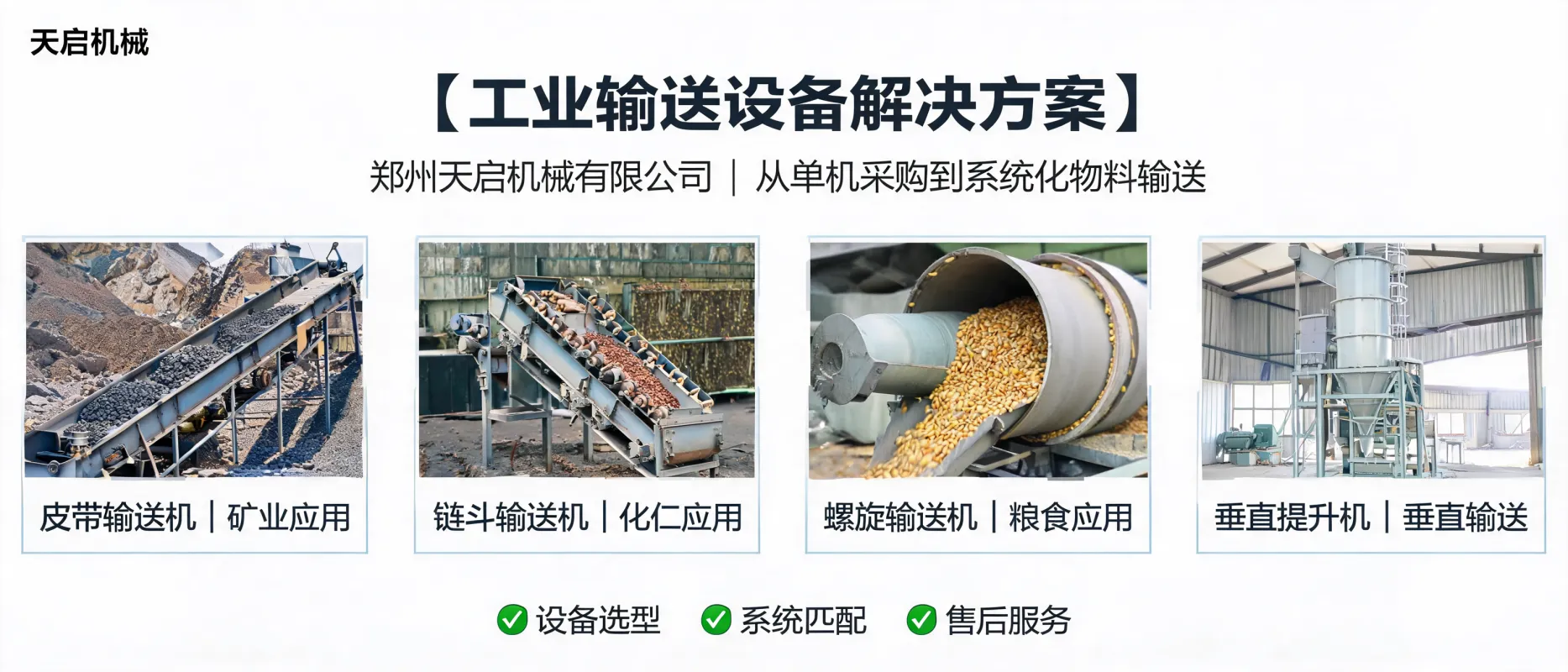
Since its establishment in 2013, ZhengZhou TianQi Machinery Co., Ltd. has focused on the research, production, and export of conveying equipment from Henan, China. The company works with B2B customers in industries including mining, chemical processing, and grain handling.
Its product range includes belt conveyors, bucket elevators, screw conveyors, and vertical lifting equipment. By reviewing the application, operating environment, equipment arrangement, and support requirements together, TianQi Machinery aims to help customers compare solutions on practical project factors rather than on the lowest standalone price.
Precise conveying, driven by the future.
Technical decisions should be supported by clear requirements, appropriate equipment selection, and dependable communication throughout the project.
Make the comparison about project fit
The most suitable conveyor solution is not necessarily the one with the lowest initial quotation. It is the option whose material compatibility, conveying capacity, site arrangement, system integration, maintenance access, export requirements, and supplier support align with the project. A clear evaluation framework gives buyers a more reliable basis for selecting equipment and managing lifecycle cost.


.png?x-oss-process=image/resize,h_100,m_lfit/format,webp)
.png?x-oss-process=image/resize,h_100,m_lfit/format,webp)
.png?x-oss-process=image/resize,h_100,m_lfit/format,webp)