How to Choose the Right Horizontal Roller Conveyor System
ZhengZhou TianQi Machinery Co., Ltd.
2026-10-04
Industry Guide
ZhengZhou TianQi Machinery’s guide compares key parameters for selecting horizontal roller conveyor systems, including capacity, speed, roller size, load requirements, drive options, modular integration, maintenance, and supplier support.

Roller Conveyor Selection Guide
Choose a Horizontal Roller Conveyor Based on the Complete Material-Handling Requirement
A suitable horizontal roller conveyor system should match the conveyed products, required throughput, layout, operating method, and future integration needs. ZhengZhou TianQi Machinery provides roller conveyor systems for transporting flat-bottomed boxes, pallets, and totes in industrial material-handling applications.
What Is a Horizontal Roller Conveyor System?
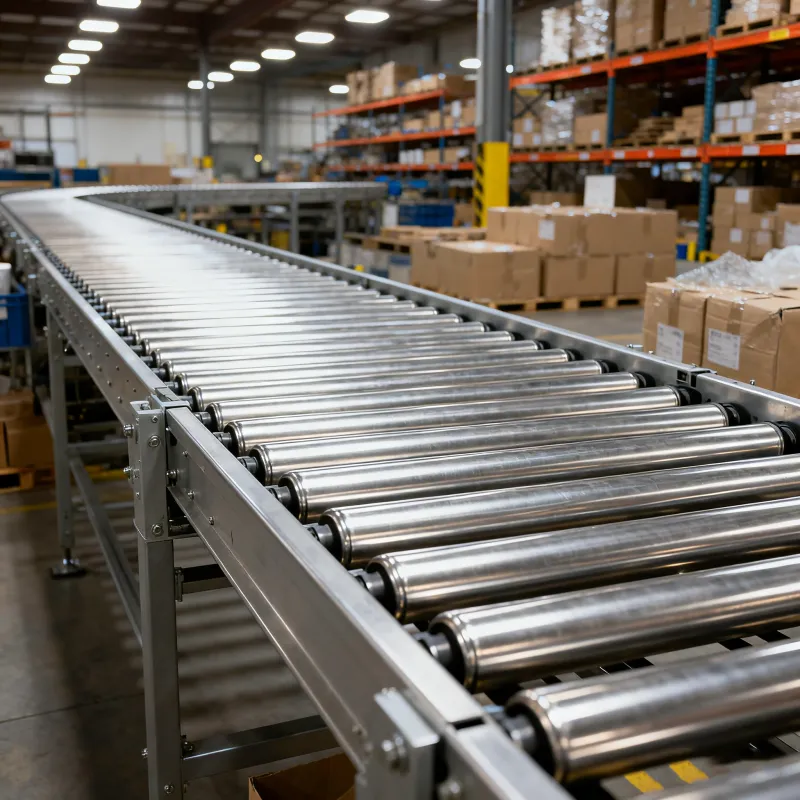
A horizontal roller conveyor uses a series of rollers to support and move products with flat, stable bases. Depending on the application, the rollers may be driven by a powered unit or allow products to move manually or through external force in a non-powered configuration.
The system typically consists of rollers, a structural frame, support legs, and a power unit where required. Its modular construction allows it to connect with other conveyors or dedicated equipment, making it suitable for production lines, warehouse handling, packaging operations, and industrial logistics workflows.
Key Parameters for Comparing Roller Conveyor Solutions
| Selection parameter |
What to evaluate |
Why it matters |
| Product and load requirements |
Product type, dimensions, bottom condition, weight, and load distribution |
Confirms that the rollers can support and move boxes, pallets, totes, or other flat-bottomed items reliably. |
| Conveying capacity and speed |
Required throughput, transport distance, accumulation needs, and operating rhythm |
Helps determine the appropriate roller arrangement and drive configuration for stable, efficient movement. |
| Conveyor width |
Product footprint, clearance, and loading or unloading conditions |
The roller conveyor width can be customized from 150 mm to 1200 mm to suit different handling requirements. |
| Roller diameter and spacing |
Product base stability, contact points, and load characteristics |
Different roller options help maintain smooth support and movement for the intended product range. |
| Drive option |
Powered or non-powered operation, control requirements, and line coordination |
Powered systems support controlled, continuous conveying, while non-powered configurations can suit simpler material-flow requirements. |
| Layout and integration |
Horizontal routing, connection points, available space, and additional equipment |
A modular structure supports integration with other conveyors and specialized equipment. |
| Maintenance and supplier support |
Accessibility, component reliability, technical assistance, and after-sales response |
Clear support arrangements help maintain dependable operation over the equipment service life. |
Powered or Non-Powered: Which Configuration Fits?
Powered Roller Conveyor
A powered configuration is appropriate when the line requires active product movement, higher operating consistency, or coordination with connected process equipment. The power unit supports controlled conveying across the planned route.
Non-Powered Roller Conveyor
A non-powered configuration can be considered for simpler transfer points or applications where products are moved manually or by an external force. The final selection should reflect product weight, movement frequency, and operator workflow.
Configuration Options for Different Handling Layouts
- Horizontal conveyingSuitable for direct transfer between workstations, storage areas, packaging points, and other line sections.
- Customized widthAvailable width options from 150 mm to 1200 mm help accommodate different product footprints and line constraints.
- Modular integrationComponents can be arranged to connect with other conveyor types or dedicated machinery.
- Multi-product handlingThe system can support the management of multiple product flows when product conditions and layout requirements are clearly defined.
A Practical Selection Process
- Define the products: confirm product dimensions, bottom shape, weight, packaging form, and stability during transport.
- Clarify the material flow: identify required capacity, conveying speed, transport distance, loading points, and discharge points.
- Review the layout: determine the required conveyor width, roller diameter, line direction, support structure, and available installation space.
- Select the drive method: compare powered and non-powered configurations according to the required control and operating method.
- Confirm integration and support: check connection with existing equipment, maintenance access, technical assistance, delivery coordination, and after-sales service.
Why Consider ZhengZhou TianQi Machinery?
Founded in 2013 and headquartered in Henan, China, ZhengZhou TianQi Machinery Co., Ltd. focuses on the research, production, and export of conveying equipment. Its product portfolio includes belt conveyors, chain bucket conveyors, screw conveyors, vertical elevators, and roller conveyor systems for industries such as mining, chemicals, and grain processing.
For roller conveyor projects, the company combines a robust modular structure with configurable width, roller diameter, drive method, and layout options. Quality control, technical support, and responsive after-sales service are part of the supplier evaluation process, particularly for customers managing industrial production and logistics operations across international markets.
Robust construction
Powered and non-powered options
Customizable dimensions
Modular integration
Match the Conveyor to the Application
The right horizontal roller conveyor is determined by the relationship between product characteristics, conveying objectives, equipment configuration, and future line integration. By reviewing these parameters before specifying the system, buyers can establish a clearer technical basis for selecting a reliable roller conveyor solution from ZhengZhou TianQi Machinery.