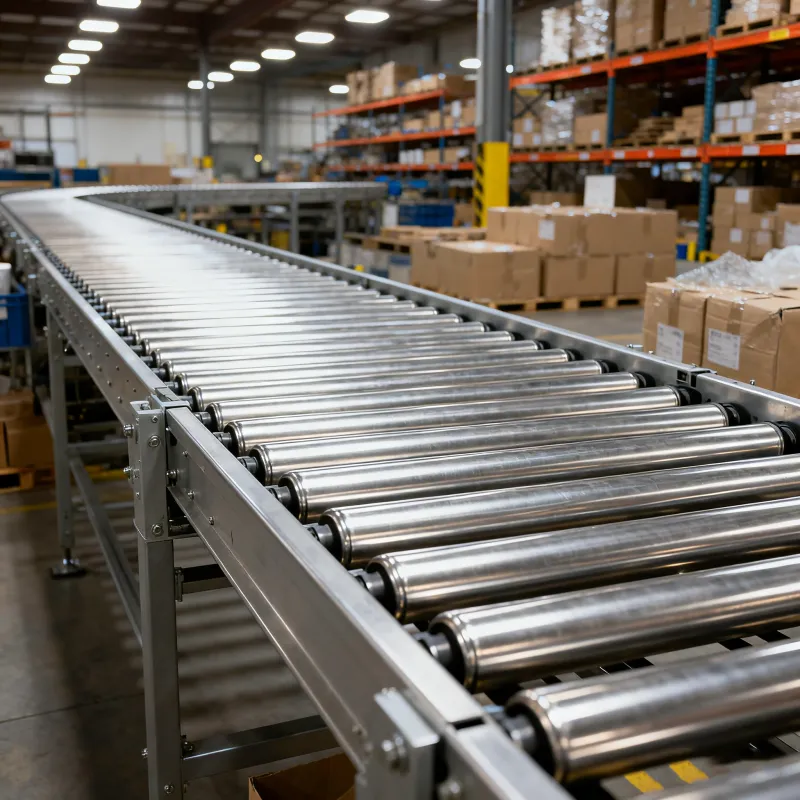
Selecting a horizontal roller conveyor system requires more than comparing equipment dimensions. The right configuration should match the conveyed product, load requirements, throughput expectations, available space, operating direction, integration needs, and maintenance conditions.
This practical guide from ZhengZhou TianQi Machinery Co., Ltd. helps production, warehousing, and logistics decision-makers evaluate the key parameters of roller conveyor systems for transporting boxes, pallets, totes, and other products with flat bottoms.
A horizontal roller conveyor system uses a series of rollers mounted within a supporting frame to move flat-bottomed items along a defined path. Depending on the application, the system can be configured as a powered conveyor or a non-powered conveyor.
A typical system may include rollers, a conveyor frame, support legs, and a power unit when driven operation is required. Its modular structure supports connection with other conveyors and dedicated equipment, making it suitable for material handling lines in manufacturing, warehousing, logistics, mining-related operations, chemical logistics, and grain processing.
| Parameter | Questions to Consider |
|---|---|
| Product and load | Are the items boxes, pallets, totes, or other flat-bottomed products? What are their dimensions, weight, and bottom condition? |
| Conveying capacity | How many units must be moved within a given operating period, and does the required throughput remain stable or vary by process stage? |
| Speed and movement | Does the line require powered movement, manual pushing, accumulation, or a controlled transfer speed? |
| Conveyor width | Will the selected width provide stable support for the product while leaving appropriate clearance for loading and discharge? |
| Roller specifications | Are the roller diameter and roller arrangement suitable for the product size, load distribution, and required operating conditions? |
| Layout and integration | Should the conveyor operate horizontally only, or should it connect with inclined, curved, or other conveying equipment? |
| Maintenance and support | Can routine inspection, cleaning, adjustment, and component replacement be completed efficiently? What technical support is available? |
Powered roller conveyors are suitable when consistent movement, faster transfer, or higher throughput is required. Non-powered configurations can be considered for applications where items move through manual handling or gravity-assisted conveying conditions.
TianQi Machinery’s roller conveyor systems can be customized with conveyor widths from 150 mm to 1,200 mm. Different roller diameter options can be evaluated according to product dimensions, load distribution, and line requirements.
A modular layout makes it easier to connect the roller conveyor with other conveyors or dedicated equipment. This is useful when a material handling line includes several transfer, sorting, loading, or processing stages.
Horizontal roller conveyor systems are particularly suitable for moving boxes, pallets, totes, and similar products with flat bottoms. Their configuration can be adapted to different material handling requirements in production lines, warehouses, distribution operations, and industry-specific logistics processes.
For heavier-duty material handling, including selected mining-related applications, chemical logistics, and grain processing lines, the product load, operating environment, and required protection level should be reviewed during system design rather than selected from conveyor dimensions alone.
The system can be planned around product type, conveying direction, width, roller selection, drive configuration, and line integration needs.
Powered and non-powered options, as well as horizontal, inclined, and curved arrangements, support different conveying layouts.
TianQi Machinery applies quality control throughout production and provides technical support and responsive after-sales service.
Established in 2013 and based in Henan, China, the company serves customers in Europe, North America, Southeast Asia, the Middle East, and other markets.
A suitable horizontal roller conveyor system should balance conveying capacity, load requirements, speed, width, roller specifications, drive configuration, modular integration, maintenance access, and supplier support. By comparing these parameters before equipment selection, buyers can develop a clearer specification for their production, warehousing, or logistics application.
With its focus on technology, quality, and responsive service, ZhengZhou TianQi Machinery Co., Ltd. provides configurable roller conveyor solutions for efficient and reliable material handling.

 475
|
 ZhengZhou TianQi Machinery integrated conveying equipment solutions roller conveyor system material handling system conveying equipment selection
484
|
ZhengZhou TianQi Machinery roller conveyor systems industrial conveying solutions material handling equipment global export services
495
|
ZhengZhou TianQi Machinery integrated conveyor equipment solutions belt conveyor bucket conveyor screw conveyor
263
|
ZhengZhou TianQi Machinery industrial conveying equipment roller conveyor system belt conveyors screw conveyors
420
|
ZhengZhou TianQi Machinery industrial conveyor equipment conveyor equipment solutions belt conveyor vertical elevator