Horizontal Roller Conveyor System Selection Guide
Choosing the right horizontal roller conveyor system requires more than selecting a conveyor width. The system must match the product type, load requirements, throughput, operating environment, layout, and integration needs. ZhengZhou TianQi Machinery Co., Ltd. provides roller conveyor solutions for the efficient handling of boxes, pallets, totes, and other products with flat bottoms.
This guide explains the main parameters to evaluate when comparing powered and non-powered roller conveyors, helping users define a practical configuration for material handling, production, warehousing, and logistics applications.
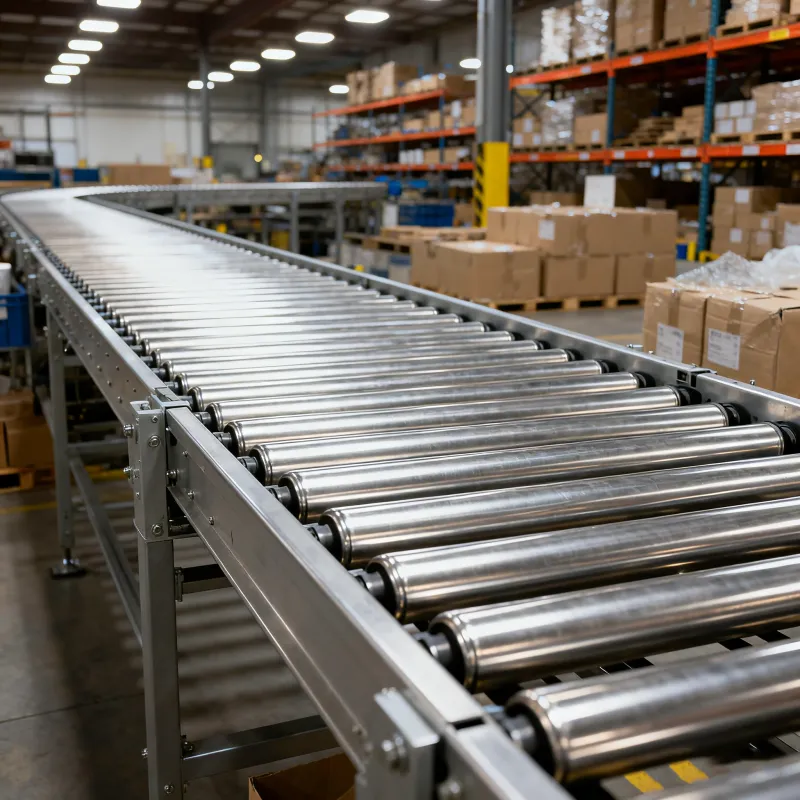
A horizontal roller conveyor system transports products along a level conveying path using a series of rollers mounted within a structural frame. Depending on the application, the rollers may be powered by a drive unit or rotated by manual pushing and product movement.
The system typically includes rollers, a conveyor frame, support legs, and a power unit when a powered configuration is selected. Its modular structure allows it to connect with other conveyors or dedicated equipment in a broader material handling line.
Roller conveyors are generally suitable for products with flat, stable bottoms, including boxes, pallets, and totes. Products should maintain sufficient contact with the rollers to move smoothly and remain stable during transport.
Determine the weight of individual loads, the number of products on the conveyor at one time, and the expected throughput. These factors influence the roller arrangement, frame design, drive selection, and overall system configuration.
The conveyor width should provide stable support while allowing sufficient clearance for the conveyed product. TianQi Machinery can customize roller conveyor widths from 150 mm to 1200 mm according to product dimensions and line requirements.
Roller diameter and spacing should be selected according to product size, bottom structure, and load distribution. A suitable arrangement helps maintain stable contact and supports smooth, reliable movement.
For high-throughput handling, the conveyor configuration should be matched to the required operating speed, product spacing, loading method, and downstream equipment. The objective is consistent movement without unnecessary accumulation or product interference.
The total length, transfer points, workstations, and available installation space should be considered before finalizing the design. A modular layout can simplify connection with other conveying or handling equipment.
Horizontal roller conveyor systems are available in powered and non-powered configurations. The appropriate choice depends on the required level of automation, product movement, line length, handling frequency, and process control.
| Configuration | Main Characteristics | Selection Considerations |
|---|---|---|
| Powered roller conveyor | Uses a drive unit to support continuous and controlled product movement. | Suitable when the line requires higher throughput, regular movement, or integration with automated equipment. |
| Non-powered roller conveyor | Relies on manual pushing or the movement of products along the roller surface. | Suitable for simpler transfer points, manual handling areas, and applications where powered movement is not required. |
Modular sections can be connected with other conveyors or specialized equipment to support different material handling layouts.
Horizontal, inclined, and curved arrangements can be considered when the complete conveying route requires more than a straight level section.
A clear structural layout supports routine inspection and helps maintenance teams access key components more conveniently.
A properly matched frame, roller arrangement, and power configuration contribute to stable conveying performance and smooth product movement.
Horizontal roller conveyor systems can be configured for a range of material handling tasks where products have flat bottoms and require stable movement. Common application considerations include:
ZhengZhou TianQi Machinery Co., Ltd. develops and manufactures conveying equipment for industrial and commercial material handling applications. Its roller conveyor system is designed for high-throughput, smooth, and stable transport of boxes, pallets, totes, and other flat-bottom products.
The system supports powered and non-powered configurations, customizable widths from 150 mm to 1200 mm, multiple roller diameter options, and modular integration with other equipment. A robust structure, practical maintenance design, and configurable layout help users build a roller conveyor solution aligned with their product and process requirements.
TianQi Machinery also provides technical support and responsive after-sales service. The company reports a 98% on-time delivery rate and serves customers across Europe, North America, Southeast Asia, and the Middle East.
Before selecting a final configuration, prepare the product dimensions, maximum load, required throughput, conveyor length, available space, operating speed, and preferred power arrangement. These details provide a practical basis for evaluating roller diameter, conveyor width, drive requirements, modular connections, installation, and maintenance needs.
With a clear understanding of these parameters, ZhengZhou TianQi Machinery can help define a horizontal roller conveyor system that supports stable product handling and efficient line integration.
 494
|
 ZhengZhou TianQi Machinery conveyor equipment solutions belt conveyor screw conveyor roller conveyor system
484
|
ZhengZhou TianQi Machinery roller conveyor systems industrial conveying solutions material handling equipment global export services
243
|
ZhengZhou TianQi Machinery Co., Ltd. conveyor equipment solutions roller conveyor system belt conveyor vertical lifting conveyor
279
|
ZhengZhou TianQi Machinery Co., Ltd. industrial conveying equipment conveying equipment solutions roller conveyor systems equipment selection
205
|
ZhengZhou TianQi Machinery Co., Ltd. conveyor equipment solutions belt conveyor bucket conveyor roller conveyor system