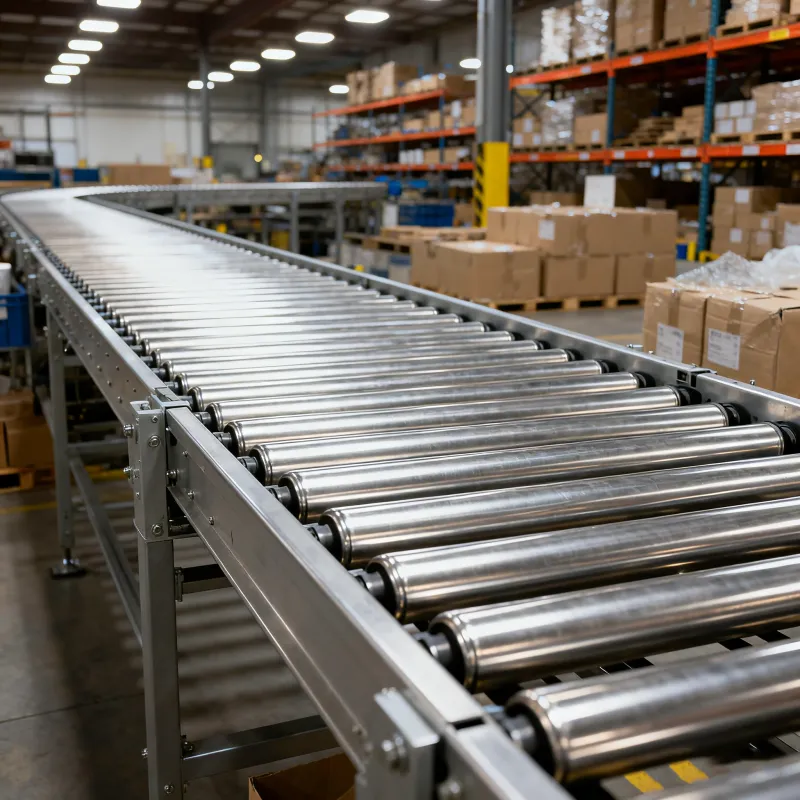
Powered roller conveyor
A powered configuration is suitable when the line requires active movement, continuous transfer, controlled flow, or integration with automated handling equipment.


Horizontal Roller Conveyor System Selection Guide
Choosing a roller conveyor system requires more than selecting a standard conveyor length. The right configuration should match the conveyed load, required throughput, transport direction, operating cycle, available space, and integration requirements.
ZhengZhou TianQi Machinery Co., Ltd. provides roller conveyor systems for the efficient handling of flat-bottomed items such as boxes, pallets, and totes. The system can be configured as powered or non-powered equipment and adapted for horizontal, inclined, or curved conveying according to actual operating conditions.
A horizontal roller conveyor system transports unit loads across a series of rollers arranged in a rigid frame. It is particularly suitable for products with a flat and stable base, including cartons, containers, pallets, and turnover boxes.
A typical system consists of rollers, a conveyor frame, support legs, and a power unit when powered conveying is required. Its modular structure supports smooth material flow and makes it easier to connect with other conveyors, processing equipment, inspection stations, or packaging lines.
| Parameter | What to Evaluate | Why It Matters |
|---|---|---|
| Conveying capacity | Required throughput, load frequency, and operating cycle | Helps determine the suitable roller arrangement and drive configuration. |
| Load size and weight | Product dimensions, base condition, weight distribution, and stability | Ensures adequate support and reliable movement across the conveyor. |
| Roller diameter and material | Roller specifications and the operating environment | Influences load support, running stability, wear resistance, and maintenance needs. |
| Conveyor width | Load width, required clearance, and line layout | Supports stable transport while making efficient use of available space. |
| Drive configuration | Powered or non-powered operation, flow direction, and control requirements | Determines how loads start, stop, accumulate, or move through the line. |
| Integration and maintenance | Connection with other equipment, installation access, and service requirements | Affects long-term usability, line coordination, and maintenance efficiency. |
The first step is to define what the conveyor will carry and how frequently the loads will enter the line. Important information includes the dimensions and weight of each box, pallet, or tote, as well as the required conveying frequency and operating cycle.
Roller diameter and material should be considered together with the load characteristics and working environment. The conveyor width should provide sufficient support for the transported item while maintaining appropriate clearance within the line layout.
ZhengZhou TianQi Machinery can customize conveyor widths from 150 mm to 1200 mm. Roller diameter options can also be selected according to the specific application, load requirements, and desired running performance.
A powered configuration is suitable when the line requires active movement, continuous transfer, controlled flow, or integration with automated handling equipment.
A non-powered configuration can be considered for applications where loads move through manual pushing, gravity, or another external handling method.
Selection note: The appropriate drive configuration depends on the load, route, required operating rhythm, and the way the conveyor will connect with upstream and downstream equipment.
A roller conveyor system may be arranged for horizontal, inclined, or curved conveying. The layout should account for available floor space, transfer positions, product flow, operator access, and connections with other conveyors or dedicated equipment.
The roller conveyor system is designed for unit-load handling and can be considered for material flow requirements involving stable, flat-bottomed products.
The rigid structure is designed for dependable long-term use.
The roller arrangement supports high-throughput and stable conveying.
Horizontal, inclined, curved, powered, and non-powered options support different layouts.
Standardized sections can be coordinated with other conveying or dedicated equipment.
The design supports routine inspection and practical maintenance access.
The system can support the organized movement of different unit-load products.
Founded in 2013 and headquartered in Henan, China, ZhengZhou TianQi Machinery Co., Ltd. focuses on the research, production, and export of conveying equipment. Its product range includes belt conveyors, chain bucket conveyors, screw conveyors, vertical elevators, and roller conveyor systems.
The company applies quality control throughout production and provides technical support and responsive after-sales service. Its stated on-time delivery rate is 98%, supporting project planning for customers in international markets.
A suitable horizontal roller conveyor system should be selected from actual load and operating conditions rather than from a single parameter. Prepare information about the product type, dimensions, weight, required capacity, conveying distance, layout, drive preference, and integration needs. ZhengZhou TianQi Machinery can use these details to evaluate a practical configuration, including conveyor width, roller diameter, operating direction, modular arrangement, and maintenance considerations.
 420
|
 ZhengZhou TianQi Machinery industrial conveyor equipment conveyor equipment solutions belt conveyor vertical elevator
349
|
ZhengZhou TianQi Machinery export trade intelligent marketing management platform customs data foreign trade CRM intelligent marketing
252
|
ZhengZhou TianQi Machinery industrial conveyor equipment conveyor equipment solutions mesh belt conveyor material handling systems
103
|
ZhengZhou TianQi Machinery conveying equipment solutions belt conveyor bucket conveyor screw conveyor
181
|
ZhengZhou TianQi Machinery Co., Ltd. industrial conveying equipment belt conveyor bucket elevator conveyor mesh belt conveyor