.png?x-oss-process=image/resize,h_100,m_lfit/format,webp)
.png?x-oss-process=image/resize,h_100,m_lfit/format,webp)
.png?x-oss-process=image/resize,h_100,m_lfit/format,webp)
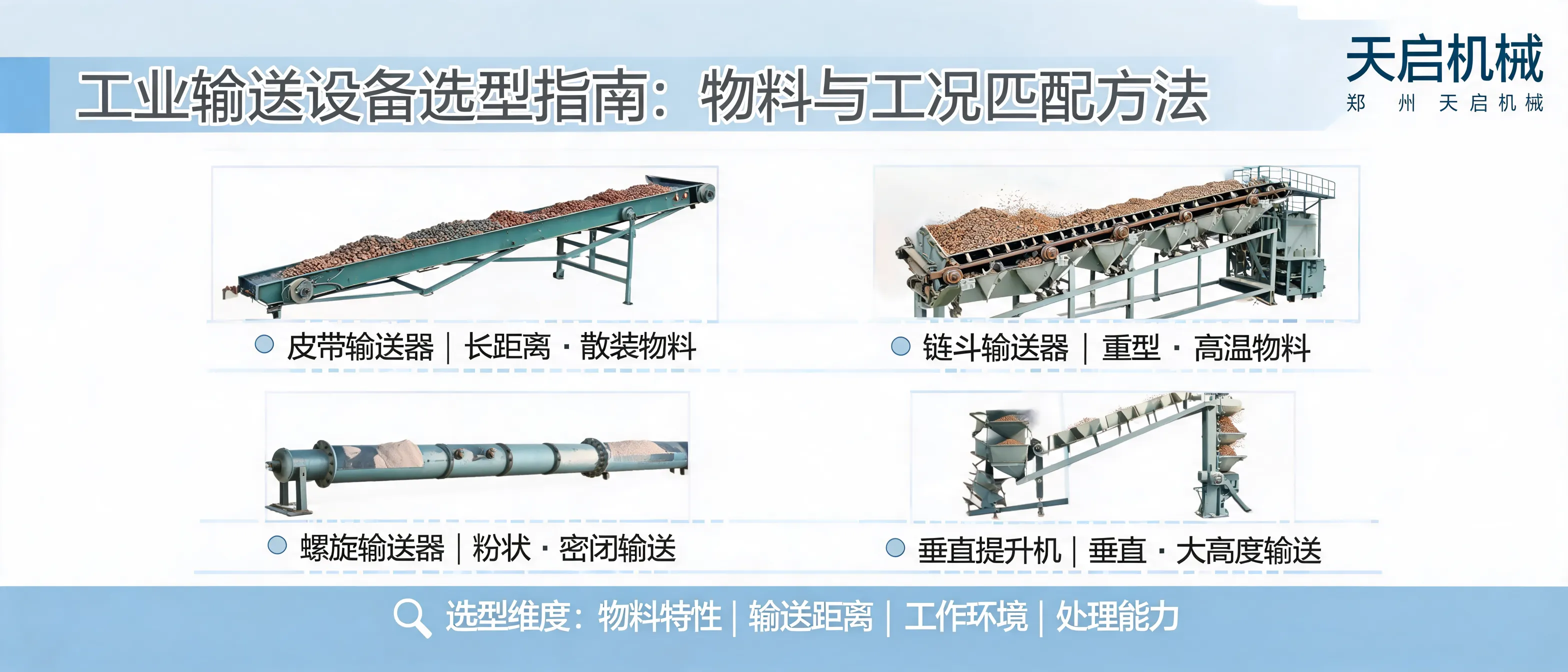
Selecting the right industrial conveying equipment requires more than comparing equipment names or purchase prices. Procurement teams, engineers, and project managers need to evaluate the material being handled, the conveying direction and distance, required capacity, working environment, and expected maintenance conditions. ZhengZhou TianQi Machinery provides conveying equipment solutions for industrial applications, including belt conveyors, bucket elevators, screw conveyors, and vertical lifts.
A suitable conveying system should match the physical characteristics of the material and the operating requirements of the production line. Before requesting a quotation or defining equipment specifications, clarify the following factors:
Each equipment type has a different operating principle and application focus. The following comparison can support an initial equipment screening before detailed engineering confirmation.
| Equipment type | Typical conveying direction | Key selection considerations | Common application logic |
|---|---|---|---|
| Belt conveyor | Horizontal or inclined | Material type, belt width, route length, incline, loading method, and environmental conditions | Continuous movement of bulk or packaged materials along a defined route |
| Bucket elevator | Vertical | Required lifting height, material flowability, bucket configuration, feed conditions, and discharge requirements | Vertical transfer of bulk materials where floor space is limited or elevation change is required |
| Screw conveyor | Horizontal, inclined, or selected process routes | Material moisture, particle size, temperature, abrasiveness, required capacity, and cleaning needs | Controlled movement of powders, granules, and other bulk materials within process equipment or transfer lines |
| Vertical lift | Vertical | Lifting route, load characteristics, cycle or continuous operation, installation space, and access requirements | Moving materials or loads between different elevations in an industrial handling system |
Material characteristics directly influence the conveying method, equipment configuration, wear protection, and maintenance approach. A system designed for free-flowing granular material may not be suitable for wet, sticky, fragile, abrasive, or high-temperature material without corresponding engineering adjustments.
Review particle size distribution, bulk density, flowability, and the possibility of segregation during conveying.
Pay attention to dust control, sealing, feeding stability, cleaning access, and the material’s tendency to bridge or accumulate.
Consider contact surfaces, wear-prone components, operating speed, inspection frequency, and replacement planning.
Assess buildup risk, discharge performance, cleaning procedures, and whether the conveying route supports stable operation.
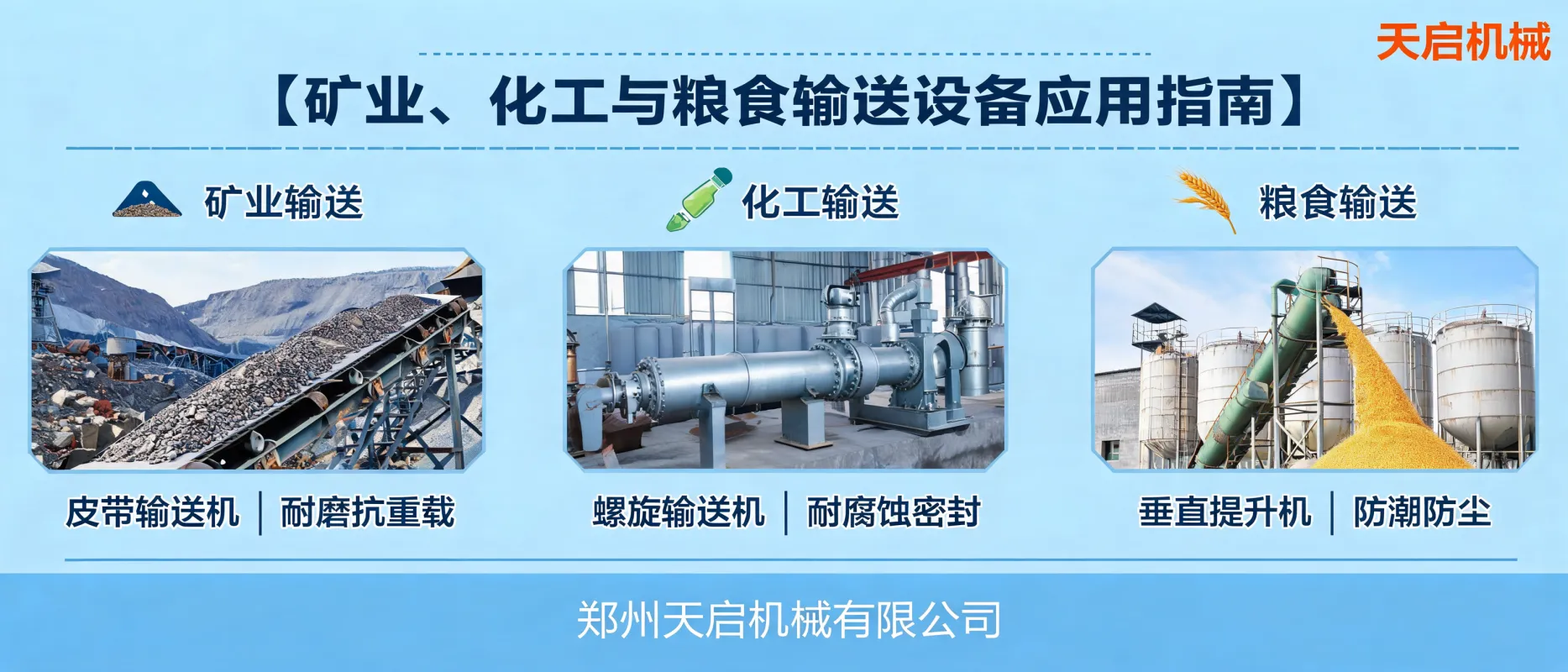
Conveying equipment selection is relevant to material handling projects in industries such as mining, chemicals, and grain processing. The correct choice depends on the interaction between material properties, route design, throughput requirements, installation conditions, and service expectations rather than on a single equipment feature.
For this reason, project teams should prepare complete operating information before finalizing specifications. ZhengZhou TianQi Machinery can use these requirements as the basis for evaluating suitable belt conveyors, bucket elevators, screw conveyors, or vertical lifts for a specific industrial conveying application.
Since each project has different materials, routes, capacities, and working conditions, equipment selection should be confirmed through application-specific technical communication. Sharing material information, conveying distance, capacity, elevation changes, installation environment, and maintenance expectations helps create a clearer basis for industrial equipment procurement.
Founded in 2013 and headquartered in Henan, China, ZhengZhou TianQi Machinery Co., Ltd. focuses on the development, production, and export of industrial conveying equipment. With the principle of technology-led development and quality-focused manufacturing, TianQi Machinery supports customers seeking practical and reliable conveying solutions for industrial material handling.

 64
|
64
|
 TianQi Machinery
foreign trade case
lead quality
follow-up efficiency
customer collaboration
321
|
ZhengZhou TianQi Machinery
belt conveyor
bucket conveyor
screw conveyor
conveyor equipment comparison
133
|
ZhengZhou TianQi Machinery Co., Ltd.
foreign trade marketing trends
data-driven customer management
customer lifecycle management
growth model
105
|
ZhengZhou TianQi Machinery Co., Ltd.
conveying equipment solution
belt conveyor
bucket elevator
screw conveyor
291
|
ZhengZhou TianQi Machinery Co., Ltd.
SaaS marketing platform selection
foreign trade enterprises
feature fit
implementation capability
TianQi Machinery
foreign trade case
lead quality
follow-up efficiency
customer collaboration
321
|
ZhengZhou TianQi Machinery
belt conveyor
bucket conveyor
screw conveyor
conveyor equipment comparison
133
|
ZhengZhou TianQi Machinery Co., Ltd.
foreign trade marketing trends
data-driven customer management
customer lifecycle management
growth model
105
|
ZhengZhou TianQi Machinery Co., Ltd.
conveying equipment solution
belt conveyor
bucket elevator
screw conveyor
291
|
ZhengZhou TianQi Machinery Co., Ltd.
SaaS marketing platform selection
foreign trade enterprises
feature fit
implementation capability